Boiler Repair in Milton Keynes
Tell Us About the Job
Tell us about the job in two minutes and we’ll come back to you with a clear, fixed price.
Boilers rarely fail without warning. They give you a fortnight of small signs first: pressure that needs topping up more often than it used to, a radiator that takes longer to warm through, a hot tap that runs cool for a few seconds before it settles. Most people notice all of it and none of it, because the house is still warm.
Then the boiler locks out, usually on the first genuinely cold night, and the callout that could have been a routine visit becomes an emergency.
We repair boilers across Milton Keynes and the surrounding towns for homeowners, landlords and commercial premises. Gas Safe registered, registration number 981362. This page covers what actually goes wrong, what you can safely check yourself before calling anyone, and when repair stops being the sensible option.
- Gas Safe registered 981362
- Fixed price agreed before we start
- Milton Keynes and 20 miles around
- 8am – 8pm, Mon to Sat
Last updated
What actually goes wrong
Pressure that keeps dropping
The single most common call we get. A sealed heating system holds a fixed volume of water. If the pressure gauge keeps falling, that water is leaving somewhere, and topping it up with the filling loop treats the symptom while making the underlying problem worse, because every top-up introduces fresh oxygenated water that accelerates corrosion inside the system.
The three usual causes:
A failed expansion vessel.
The vessel absorbs the expansion of water as it heats. When the internal bladder fails or the vessel loses its air charge, pressure swings wildly between cold and hot, and the pressure relief valve discharges to get rid of the excess. That discharge runs to a small copper or plastic pipe outside, often dripping unnoticed onto a path.
A leak on the system.
Radiator valves, towel rail connections, or a buried pipe under a floor. Heating water is dark and rusty, so the stains look different from a clean water leak.
A weeping pressure relief valve.
Once it has passed debris across the seat, it may not close fully afterwards.
The expansion vessel is the one most often missed, because there is nothing to see. It is also usually repairable rather than requiring a new boiler.
Lockout and fault codes
Modern boilers shut themselves down and display a code rather than continuing to run in an unsafe or damaging state. That is the boiler protecting itself, and resetting it repeatedly without finding out why is how a small fault becomes a component failure.
Photograph the code and the boiler’s data plate before you call. It tells us what to bring, which often turns two visits into one.
Hard water and the heat exchanger
Milton Keynes sits in Anglian Water’s supply region and the water is very hard. The city average runs around 300 mg/l of calcium carbonate, with MK8 measuring roughly 317 against a UK average of 207. Anything over 300 leaves visible scale on a kettle element within weeks.
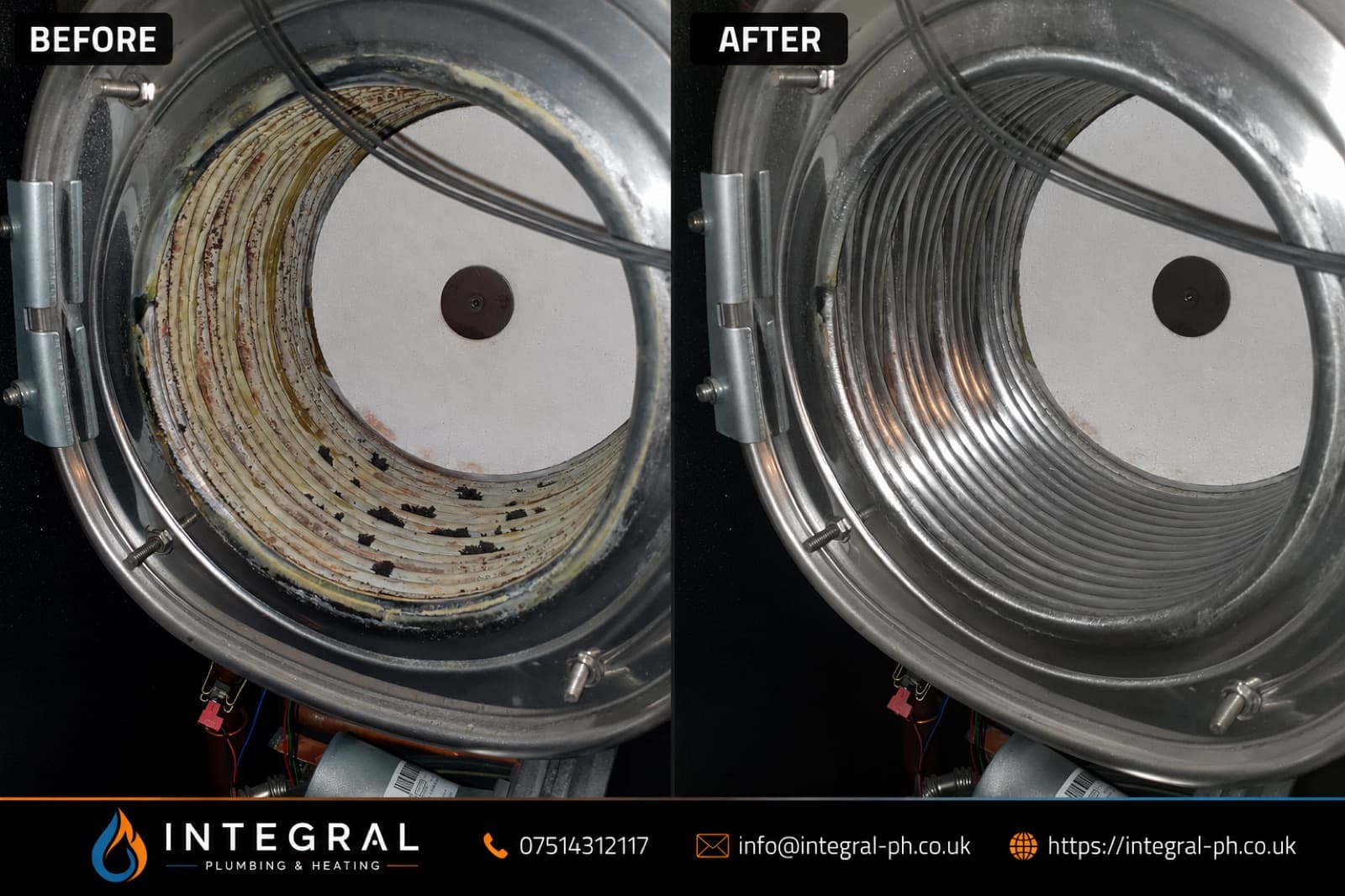
Inside a combi, that scale forms on the plate heat exchanger that produces your hot water. The symptom is distinctive: the heating works perfectly, the radiators are hot, but the hot tap runs hot, then cools, then comes back. People assume the boiler is failing. Often it just needs the exchanger cleaning or replacing, and a scale reducer fitting so it does not happen again.
Frozen condensate pipe
The most common winter shutdown, and often fixable without an engineer. Condensing boilers produce acidic water that drains through a plastic pipe, usually white or grey and around 22mm. If that pipe runs outside and freezes, the boiler locks out.
Pouring warm water, not boiling, along the external section will usually clear it, and the boiler will restart after a reset. If it refreezes the next morning, the pipe needs re-routing or lagging properly rather than being thawed every day.
Pump, diverter valve and thermistor faults
The three components that fail most on a boiler past its eighth year. A seized pump means no circulation. A failed diverter valve means the boiler cannot switch between heating and hot water, which produces the two symptom patterns below.
No heating, but the hot water works
If the hot taps are fine and the radiators are cold, the fault is almost always on the heating side rather than the boiler as a whole. Common causes:
- Diverter valve stuck in the hot water position
- Room thermostat or programmer failure, including flat batteries in a wireless stat
- Pump failure or a seized pump
- Air lock or heavy sludge preventing circulation
- Zone valve failure on a system with separate upstairs and downstairs circuits
Worth checking first: the programmer is on and set correctly, the room thermostat is calling for heat and its batteries are good, the pressure gauge reads roughly 1 to 1.5 bar cold, and no radiator valves have been closed by accident.
No hot water, but the heating works
The mirror image, and again usually a diverter valve or, on a combi, the plate heat exchanger. On a cylinder system, look at the immersion, the cylinder thermostat and the motorised valve serving the cylinder coil.
If you have a cylinder and the water is lukewarm rather than absent, a scaled coil is a strong candidate in this area.
Before you call: what to check
- Is there gas to the property? Check the hob lights.
- Is the boiler getting power? Check the fused spur and the consumer unit.
- Pressure gauge reading, photographed. Roughly 1 to 1.5 bar when cold.
- Any fault code on the display, photographed.
- Programmer on, correct time, correct schedule. Clocks going back catches people out every autumn.
- Room thermostat calling for heat, batteries good.
- Condensate pipe outside: is it frozen?
- Radiator valves open, including the thermostatic ones which can seize closed over summer.
Five minutes on that list solves a surprising number of callouts and shortens the rest.
Boiler repair in Milton Keynes: the local picture
Because Milton Keynes was built in phases from 1967 onwards, boiler age tracks the estate more closely than it does in most towns.
The 1970s areas, Beanhill, Coffee Hall, Netherfield, Fishermead, Conniburrow and Bradville, are typically on their second or third boiler, often fitted to small bore pipework that was never upgraded. Sludge is a recurring theme, and a repair that ignores system water condition tends not to last.
The 1980s and 1990s estates, Furzton, Emerson Valley, Shenley Brook End and Loughton, sit in the window where a system boiler and cylinder installed in the late 1990s is now well past its expected life. These are the properties where the repair or replace conversation comes up most often.
The newer estates, Brooklands, Whitehouse, Fairfields, Oakgrove, Tattenhoe Park and Glebe Farm, have younger boilers but frequently have underfloor heating on the ground floor, which adds manifolds, actuators and blending valves to the list of things that can fail.
Older property in Stony Stratford, Newport Pagnell, Olney and the Wolverton terraces tends to have mixed pipework and less accessible runs, which makes diagnosis slower and makes it more worth doing properly.
Repair or replace
An honest engineer will tell you when a repair is not worth doing. Our rough guide:
Repair is usually right when
the boiler is under about ten years old, the part is available, the fault is a single identifiable component, and the rest of the appliance is sound.
Replacement is worth considering when
the boiler is past twelve to fifteen years, parts are becoming obsolete, you have paid for two or more repairs in the last couple of years, the heat exchanger itself has failed, or the appliance is a non-condensing model that is costing you noticeably more to run than a current one would.
We will give you the repair cost and a straight opinion on whether we would spend it on our own house. If the answer is that the money is better going towards a replacement, we will say so, and you are free to get other quotes.
How our repair visits work
- 1
You call or WhatsApp. A photo of the fault code and the pressure gauge helps enormously.
- 2
We diagnose properly rather than swapping parts to see what happens.
- 3
You get a fixed price for the repair before anything is dismantled.
- 4
If the part needs ordering, we tell you the realistic timescale and we make the property safe in the meantime.
- 5
We check the system water condition while we are there, because a repair on a sludged system is a repair with a short life.
- 6
We clear up.
Booked repairs run Monday to Saturday, 8am to 8pm, with same-day availability. Emergency cover is available out of hours for genuine emergencies, particularly no heating in cold weather where there is a vulnerable person in the property.
Frequently asked questions
My boiler pressure keeps dropping. How serious is that?
It means water is leaving a sealed system. It rarely fixes itself, and repeated topping up accelerates internal corrosion. Worth diagnosing rather than managing.
Can you repair any make of boiler?
We work on all the major domestic brands. Where a manufacturer restricts parts supply to their own approved network, we will tell you straight away rather than leaving you waiting.
How quickly can you get to me?
Same-day where possible within Milton Keynes and the surrounding towns. If it is out of hours and it is an emergency, call and we will tell you honestly what we can do and when.
Should I keep resetting the boiler?
Once is reasonable. Repeatedly is not. A boiler locks out for a reason, and forcing it to run past a fault is how a cheap repair becomes an expensive one.
Is it worth repairing a boiler that is fifteen years old?
Sometimes, if the fault is small and everything else is sound. Often not. We will price the repair and give you a straight view rather than steering you towards a new boiler by default.
Do you cover rental properties?
Yes, and we work with landlords across Milton Keynes on both repairs and annual gas safety certificates. We can deal directly with tenants for access if you would rather not coordinate it.
Do you work on commercial boilers?
Yes, for offices, shops and small commercial units. Tell us the property type and appliance when you get in touch so we arrive with the right kit.
Why does my hot water go hot, then cold, then hot again?
Classic scaled plate heat exchanger on a combi, and very common in this area given the water hardness. Usually repairable, and worth fitting a scale reducer afterwards.
You may also need
Get it looked at
Call 07514 312117 or send a WhatsApp with a photo of the fault code. Gas Safe registered 981362, CIPHE member, fully insured.