
Unvented Hot Water Cylinder Installation and Servicing in Milton Keynes
Tell Us About the Job
Tell us about the job in two minutes and we’ll come back to you with a clear, fixed price.
If you have two bathrooms and one of them is unusable while the other is in use, you do not have a shower problem. You have a hot water system problem, and an unvented cylinder is usually the answer to it.
An unvented cylinder stores hot water at mains pressure. No loft tanks, no gravity, and the same pressure at every outlet in the property regardless of how many are open. It is the reason a shower in a newer Milton Keynes house behaves differently from one in a 1980s property with a cylinder in the airing cupboard and a tank above it.
We install and service unvented cylinders across Milton Keynes and the surrounding towns, in homes, rental properties and commercial premises. Gas Safe registered, registration number 981362.
- Gas Safe registered 981362
- Fixed price agreed before we start
- Milton Keynes and 20 miles around
- 8am – 8pm, Mon to Sat
Last updated
What it is, and what it replaces
Compared with a vented cylinder
The traditional setup is a cylinder fed by a cold tank in the loft, with hot water pressure produced by the height difference between the tank and the tap. That gives you low pressure, which is why showers on those systems are often disappointing and why shower pumps exist.
An unvented cylinder is fed directly from the mains and is sealed. Hot water arrives at close to mains pressure. It also frees up the loft, since the tanks go.
Compared with a combi
A combi heats water on demand and stores none. It is efficient, compact, and entirely limited by your incoming mains flow rate. Open two outlets and the flow divides between them.
A cylinder stores heated water, so simultaneous demand is not a problem until the cylinder runs low. The trade-off is that it takes up space and it does eventually run out, at which point it needs time to reheat.
The rule of thumb we use: one bathroom, or two that are never used at once, a combi is usually right. Two bathrooms in genuine simultaneous use, or a household where several people shower in the same half hour, a cylinder is usually right.
What the installation actually needs
Incoming mains flow rate, which decides everything
An unvented cylinder delivers what your mains can supply. If the incoming main to the property is weak, the cylinder will still be an improvement on gravity, but it will not produce the performance the brochure describes.
We measure flow rate and static pressure before recommending anything. If the main will not support what you want, the honest conversation is about upgrading the supply pipe, not about buying a bigger cylinder.
The discharge arrangement
This is the part that distinguishes a proper installation from a quick one.
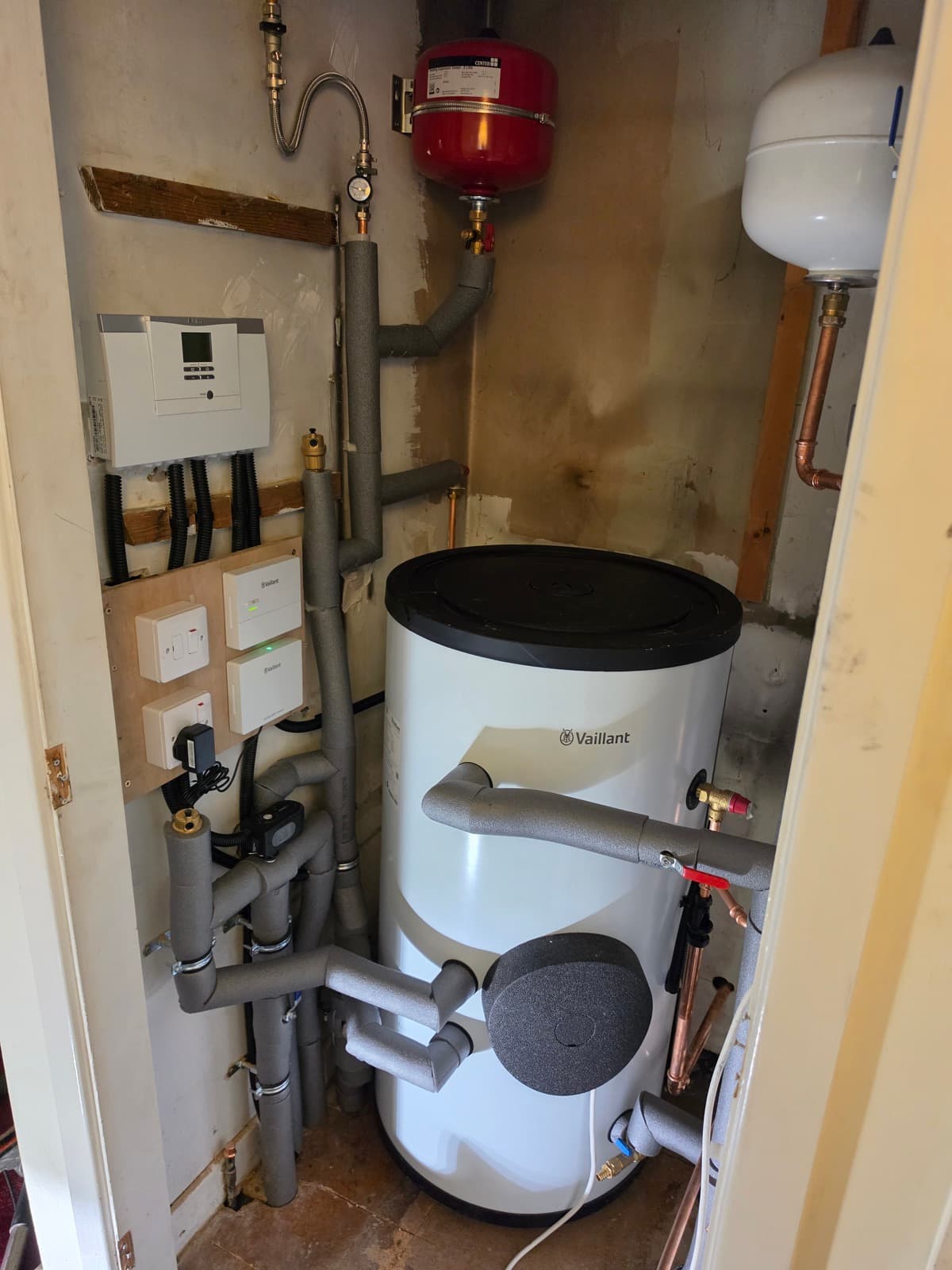
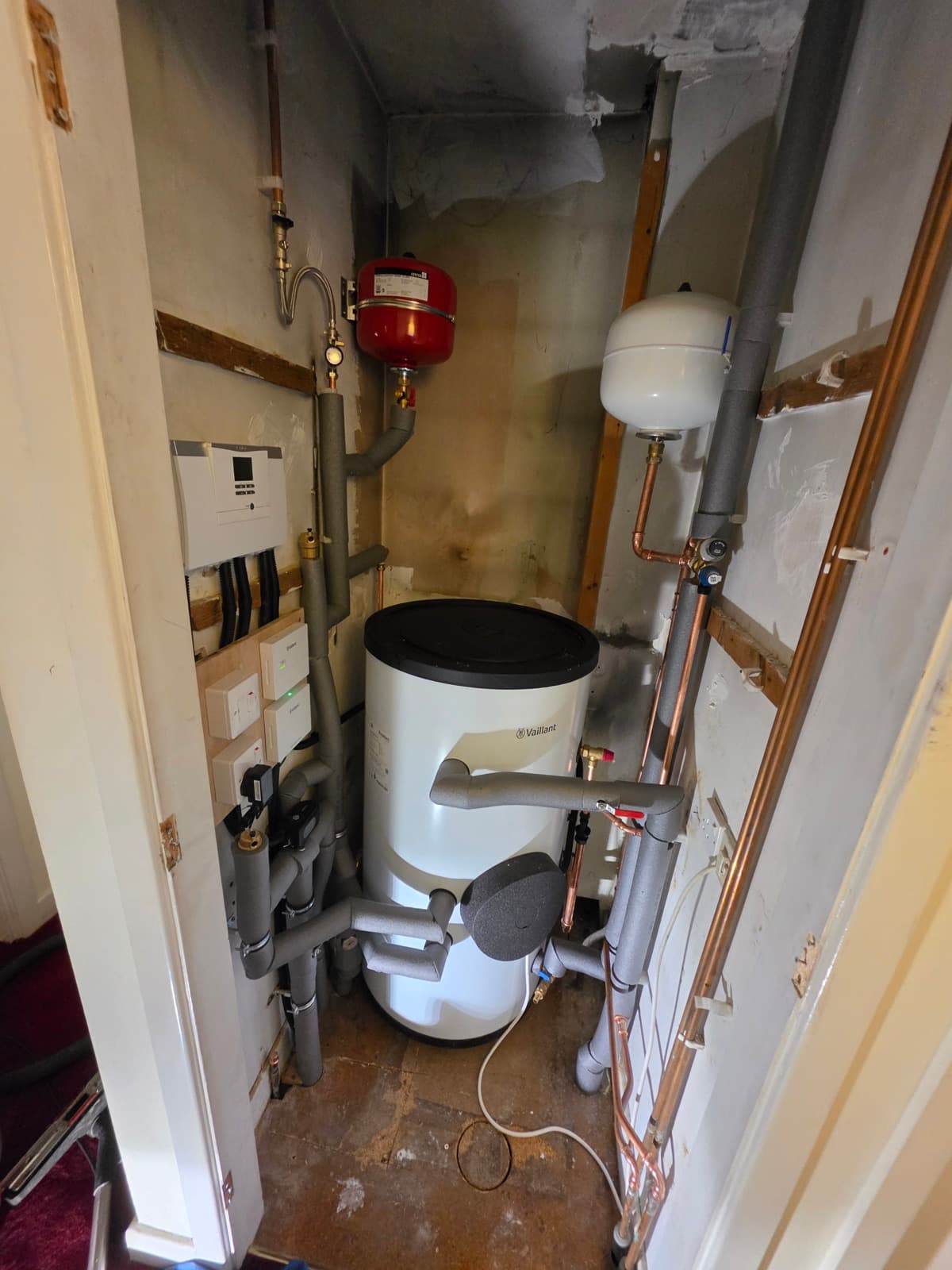
An unvented cylinder holds water above 100°C potential under pressure, so it carries safety devices that will discharge water if something goes wrong. That discharge has to go somewhere safe, through a correctly sized pipe, via a tundish so that any discharge is visible and somebody notices it.
Getting this wrong is not a cosmetic issue. The discharge route needs to terminate somewhere it cannot scald anyone and where it will be seen. On upper-floor cylinder positions this is frequently the constraint that decides where the cylinder can go.
Space and access
Cylinders are large and they are heavy when full. You need somewhere to put it, structural support appropriate to the weight, and access for future servicing. A cylinder boxed into a space nobody can get a hand into is a cylinder that will not get serviced.
Notification
Unvented hot water installation is notifiable work under the Building Regulations, and the installation should be notified with documentation provided to you afterwards. Keep it with your property paperwork.
The safety devices, and why the annual service is not optional
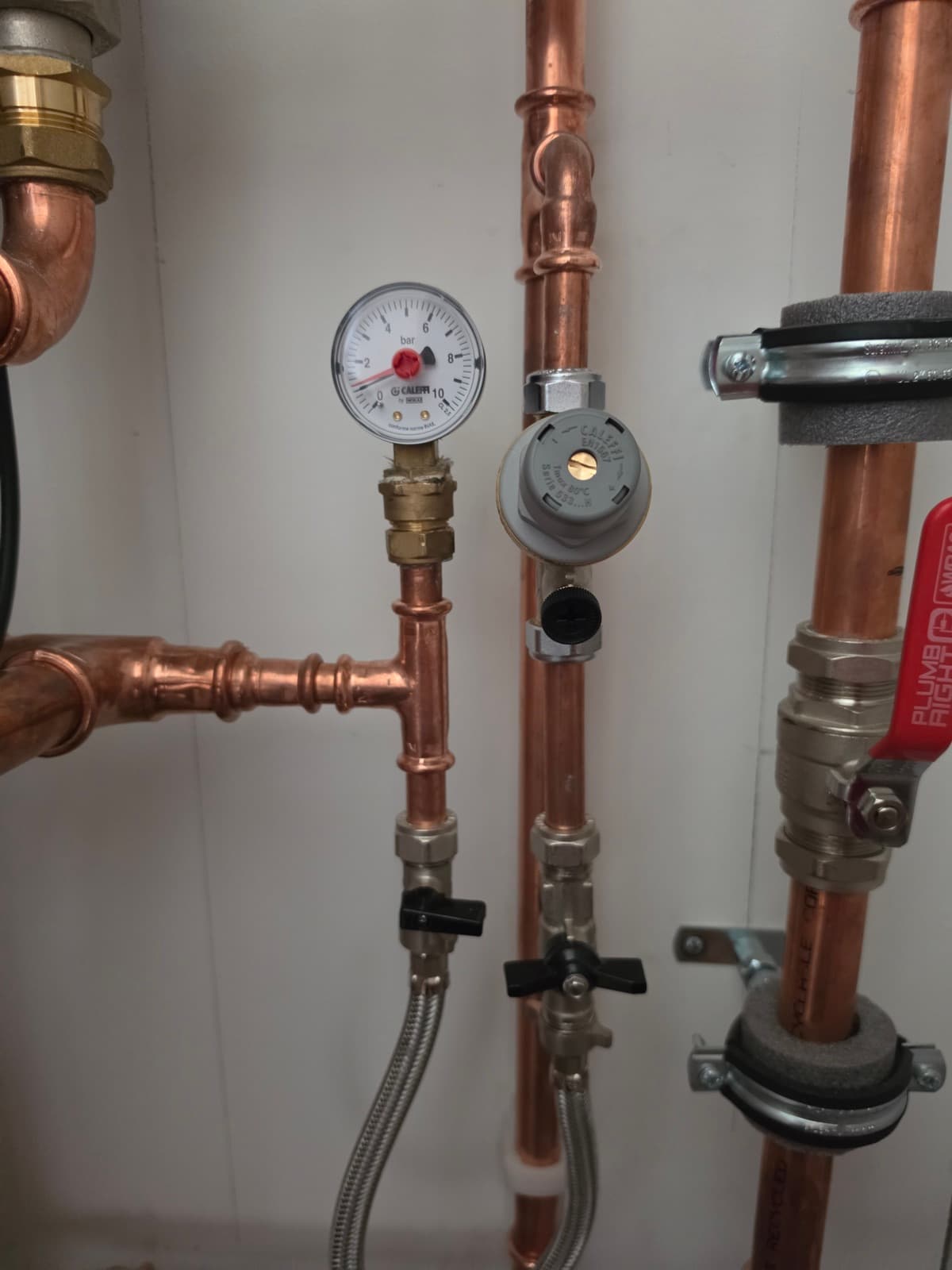
An unvented cylinder is a pressure vessel. It carries several layers of protection, and the annual service exists to confirm every one of them still works.
The expansion vessel.
Water expands as it heats. In a sealed system that expansion needs somewhere to go, and the vessel absorbs it. Vessels lose their air charge over time. When that happens, the pressure relief valve starts discharging on every heating cycle, which is why an unvented cylinder that has begun dripping to outside usually needs the vessel recharging or replacing rather than a new valve.
The temperature and pressure relief valve.
The last line of protection. It should be tested at every service, not assumed.
The pressure reducing valve
on the incoming supply, which keeps the cylinder within its working pressure.
The thermal cut-out
, which shuts the heat source down if the control thermostat fails.
An annual service checks each of these, tests the discharge route, checks the vessel charge, and confirms the operating temperatures. This is genuinely different from servicing a boiler and it is the reason unvented cylinders come with an annual service requirement attached to the warranty.
Skipping it is how a cylinder ends up dripping continuously from a discharge pipe for eighteen months while somebody assumes it is condensation.
Hard water and the cylinder coil
Milton Keynes is supplied by Anglian Water and the water here averages around 300 mg/l of calcium carbonate, with MK8 at roughly 317 against a UK average of 207. That is in the very hard band.
Anywhere water is held at temperature, scale forms on the hot surface. On a cylinder that means the heating coil and, if fitted, the immersion element. Scale on the coil means the cylinder takes longer to reach temperature and eventually never quite gets there, which people usually interpret as a boiler problem.
Two practical responses. Set the storage temperature appropriately rather than at maximum, bearing in mind it needs to stay high enough to control legionella, so this is a setting for your engineer rather than for you. And consider whether a softener is worth it, particularly if you are already spending on a bathroom. Our hard water guide covers the full picture.
Unvented cylinders in Milton Keynes: the local picture
Newer estates, Brooklands, Whitehouse, Fairfields, Oakgrove, Tattenhoe Park and Glebe Farm, were frequently built with unvented cylinders as standard. If you live in one of these, you probably already have one, and the relevant question is whether it has been serviced annually since it was fitted. Often it has not.
1980s and 1990s estates, Furzton, Emerson Valley, Shenley Brook End and Loughton, are the classic conversion candidates. Vented cylinder in the airing cupboard, tanks in the loft, weak shower, and a household that has grown since. Converting to unvented is usually the single biggest improvement available to those properties.
1970s estates, Beanhill, Coffee Hall, Netherfield, Fishermead and Conniburrow, need the mains supply checking carefully first, because the original supply pipes to some of these properties are not generous. It is worth knowing before rather than after.
Older property in Stony Stratford, Newport Pagnell, Olney and Wolverton frequently has the space for a cylinder but awkward discharge routes, particularly where the natural cupboard position is a long way from an external wall.
Sizing
Sized on the number of bathrooms and the household’s peak simultaneous demand, not on the size of the house. Undersize it and you run out mid-shower. Oversize it and you are paying to keep water hot that nobody uses, plus you have given up more cupboard space than you needed to.
The other factor is reheat rate, which depends on the boiler output and the coil. A smaller cylinder that reheats quickly can outperform a larger one that reheats slowly, depending on how the household actually uses hot water.
Before you commit
- Have the incoming mains flow rate and pressure measured
- Confirm where the discharge pipe will run and where it terminates
- Check the cylinder position can take the weight when full
- Confirm access for annual servicing, not just for installation
- Agree the size against your actual peak demand
- Check the reheat time against how your household showers
- Confirm the installation will be notified and that you receive the documentation
- Book the first annual service before you need reminding
- Ask what happens to the loft tanks and the space they free up
Frequently asked questions
Will an unvented cylinder improve my shower?
Almost always, if you are currently on a gravity system. It gives you mains pressure hot water at every outlet. If your incoming main is weak, the improvement is smaller, which is why we measure first.
Do I still need a shower pump?
No. Shower pumps exist to compensate for gravity-fed low pressure. They cannot be used on an unvented system and are not needed on one.
How often does it need servicing?
Annually. The safety devices need testing and the expansion vessel charge needs checking. Most warranties require it.
Water is dripping from a pipe outside near the cylinder. Is that normal?
No. That is the discharge from a safety device, and continuous discharge usually means the expansion vessel has lost its charge or a valve is not seating. It should be looked at rather than ignored.
Can I fit one in a flat?
Often yes, though the discharge route and the incoming supply need checking, and some leases have restrictions. We check both at survey.
Will it run out of hot water?
Eventually, like any stored system. Correct sizing and a good reheat rate mean most households never notice. Undersizing is what produces the complaint.
Can you service a cylinder you did not install?
Yes, including cylinders in newer estate properties that have never been serviced since the developer fitted them.
Do you install cylinders in commercial premises?
Yes, for offices, shops and small commercial units.
You may also need
Get the flow rate measured first
Call 07514 312117 or send a WhatsApp. Gas Safe registered 981362, CIPHE member, fully insured.